
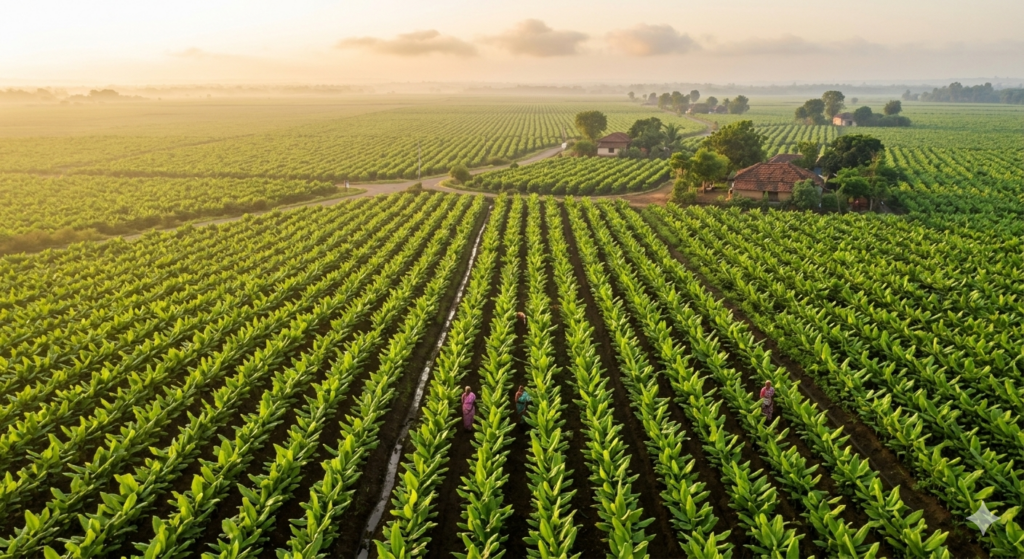
Long before it found its way into Western smoothie bowls and golden lattes, turmeric was quietly shaping civilisations. For more than four thousand years, this vivid golden-yellow rhizome has woven itself into the kitchens, temples, wedding ceremonies, and healing traditions of South Asia and beyond. Understanding the history of turmeric is to trace a thread that runs through some of the oldest and richest cultures on earth.
In this post, we trace the remarkable journey of turmeric — from the river valleys of ancient India to the spice routes of the medieval world, and ultimately to the global pantry it occupies today. Whether you are a curious cook, an Ayurveda enthusiast, or simply someone who reached for the golden spice this morning, this is the story behind what you are holding.
What Is Turmeric? A Brief Botanical Introduction
Turmeric is the dried and ground rhizome of Curcuma longa, a flowering plant in the ginger family (Zingiberaceae). Native to the Indian subcontinent and parts of Southeast Asia, it thrives in tropical climates with heavy rainfall, rich soil, and warm temperatures. The plant can reach up to one metre in height, producing elegant white and pale yellow blooms — but it is the knobby underground rhizome, orange-fleshed and intensely aromatic, that has captured human attention for millennia.
In Sanskrit, turmeric has been given many names, each reflecting a different facet of its character. Haridra — meaning ‘the yellow one’ — is the most common Ayurvedic name. It is also called Kanchani (golden goddess), Nisha (night, perhaps reflecting its use in evening rituals), and Rajani (the queen). These names alone hint at the reverence the plant commanded in ancient India.
| Quick Fact Turmeric’s brilliant yellow colour comes from a group of compounds called curcuminoids, the most prominent of which is curcumin. It is so potent as a dye that ancient traditions used it to colour everything from cloth to food to sacred powders. |
Ancient Origins: Turmeric in the Vedic World
The earliest documented use of turmeric traces back approximately 4,000 years to the Vedic civilisation of ancient India, where it played a central role in both daily life and spiritual practice. Archaeological evidence from sites in the Indus Valley — among the world’s oldest urban civilisations — suggests turmeric was already in use around 2500 BCE, making it one of the most ancient cultivated spices known to humanity.
In the sacred Vedic texts, turmeric appears under the name Haridra as both a culinary spice and a ritual substance. The Atharva Veda, one of the four foundational Hindu scriptures composed around 1500–1200 BCE, references the plant in the context of traditional preparations and its ceremonial significance. Turmeric was considered auspicious — a symbol of purity, prosperity, and the divine feminine.

In Vedic ritual, a paste of turmeric was applied to the body during religious ceremonies, weddings, and festivals. This practice survives to this day in the Haldi ceremony, a pre-wedding ritual observed across much of India, Pakistan, and Bangladesh, in which the bride and groom are anointed with turmeric paste by family members. The ceremony is believed to bless the couple, ward off ill fortune, and impart the golden glow of prosperity.
“From ancient scrolls to modern smoothie bowls, turmeric has never truly left us — it has simply changed the vessels it travels in.”
Turmeric in Classical Ayurveda: The Physicians of Ancient India
As Ayurveda — the traditional Indian system of wellness — developed and codified its principles over centuries, turmeric became one of its most highly regarded herbs. The two great classical texts of Ayurveda, the Charaka Samhita and the Sushruta Samhita (compiled broadly between 600 BCE and 700 CE, though incorporating far older oral traditions), include turmeric prominently among the Ayurvedic pharmacopoeia.
In Ayurvedic philosophy, every substance is understood through its rasa (taste), virya (potency), and vipaka (post-digestive effect). Turmeric is described as having a bitter and pungent taste, a heating potency, and a pungent post-digestive effect. These properties made it particularly valuable in the context of supporting digestive fire, or Agni, and in balancing the three doshas — Vata, Pitta, and Kapha.
Classical Ayurvedic practitioners used turmeric in a remarkable range of preparations. It appeared in Haridrakhand, a traditional sweet preparation still made today; in medicated ghees and oils; in herbal pastes applied externally; and in preparations combined with milk, honey, or warm water. Importantly, Ayurveda understood turmeric as tridoshic — capable of supporting balance across all three constitutional types — when used appropriately, which made it unusually versatile.
| Ayurvedic Note In Ayurvedic tradition, turmeric is classified as a Raktashodhaka — a blood-purifying herb — and a Krimighna — an agent traditionally associated with cleansing. These classifications reflect the Ayurvedic worldview, not modern clinical claims. |
Beyond India: Turmeric in China, Southeast Asia & Beyond
By around 700 CE, turmeric had made its way eastward into Chinese medicine, where it appears in classical texts under the name Jianghuang (“river yellow”). Traditional Chinese medicine valued the rhizome for its warming qualities and incorporated it into preparations aimed at supporting circulation and digestion. It was used to address what Chinese medicine termed stagnation — a concept loosely analogous to blockage or imbalance in the body’s vital energy.
In Southeast Asia, turmeric became deeply embedded in the culinary and cultural fabric of Indonesia, Thailand, Malaysia, Vietnam, and the Philippines. In Indonesia, a traditional herbal tonic called jamu — one of the world’s oldest herbal medicine traditions — features turmeric as a foundational ingredient, paired with ginger, tamarind, and other botanicals. Jamu is still widely consumed across Indonesia today, both as a daily wellness drink and as a cultural inheritance.
Thai cuisine developed its own rich relationship with fresh turmeric root, incorporating it into aromatic curry pastes alongside lemongrass, galangal, and kaffir lime. In the Philippines, turmeric — known locally as luyang dilaw — has long been used in both cooking and traditional folk preparations. Across Polynesia, turmeric has been used ceremonially as a body dye and sacred pigment for generations.
Travelling the Spice Routes: How Turmeric Reached the World
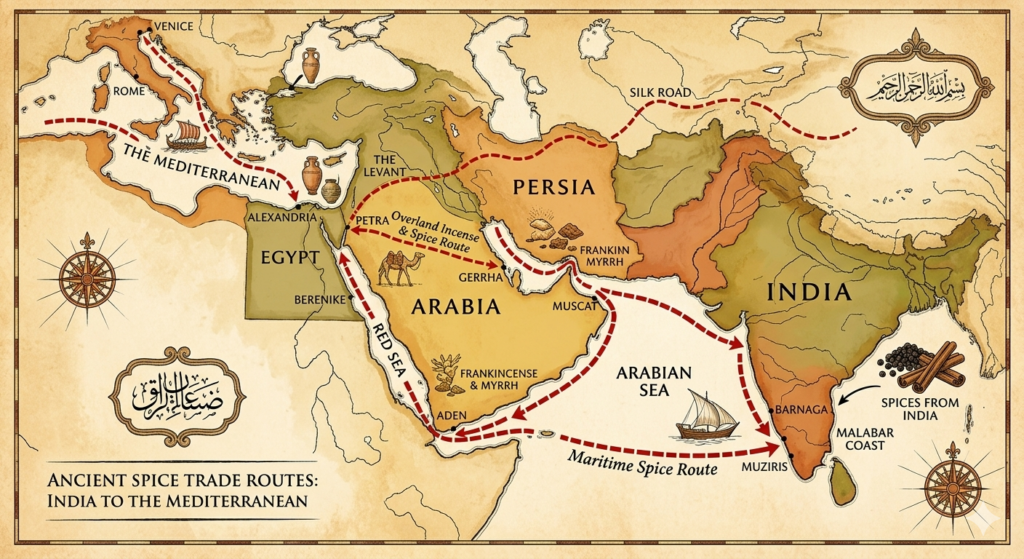
The ancient spice trade routes — stretching from the ports of Kerala in South India, across the Arabian Sea, through the Persian Gulf, and into the markets of the Middle East and Mediterranean — were the arteries through which turmeric spread westward. Arab traders, who dominated much of the Indian Ocean spice trade from the early centuries CE onwards, were instrumental in carrying turmeric to the Middle East, East Africa, and eventually Europe.
By the medieval period, turmeric had earned a place in the Middle Eastern kitchen, where it was prized as a colouring and flavouring agent. In Persia and across the Arab world, a spice known as kurkum (from which the name curcumin is derived) was used to lend colour to rice dishes, stews, and pastries. The word itself shares roots with the Latin *terra merita* — literally ‘worthy earth’ — which European traders used to describe the spice, likely due to its resemblance to saffron in its colouring properties.
Portuguese explorers, arriving in India in the late 15th century and establishing trading posts along the Malabar Coast, were among the first Europeans to systematically export turmeric to Europe. By the 16th and 17th centuries, it had begun appearing in European kitchens — primarily as a cheaper substitute for saffron, which was considerably more expensive. It also gained a foothold in European folk traditions as a dye plant, used to colour textiles, leather, and paper.
Turmeric in Africa, the Caribbean & the Americas
The movement of people, spices, and plants during the colonial era — however fraught the history of that period — also carried turmeric to new corners of the world. Turmeric cultivation spread to East and West Africa, where it became integrated into local cooking and traditional practices. In parts of West Africa, it became associated with festive foods and ritual preparations.
In the Caribbean, turmeric arrived with the indentured labourers brought from India to work on sugar plantations following the abolition of slavery in the British Empire. The Indian diaspora communities of Trinidad, Jamaica, Guyana, and Martinique brought their culinary and cultural traditions with them, including turmeric. Today, Trinidadian curry — with its characteristic golden hue — carries the direct thread of this history in every dish.
Turmeric cultivation also took root in Jamaica, where it became known locally as ‘yellow ginger,’ and in parts of Latin America, particularly in Peru and Colombia, where small-scale cultivation continues. In each place it landed, turmeric was adopted, adapted, and woven into the local food culture, demonstrating its extraordinary versatility.
Turmeric in the Modern Era: From Curry Powder to Global Superfood
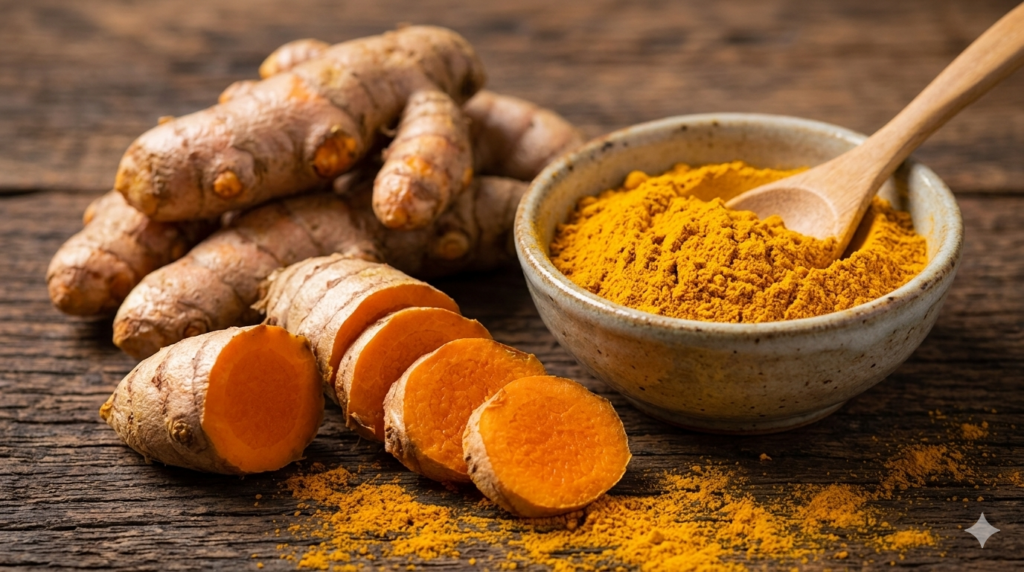
For much of the 19th and 20th centuries in the Western world, turmeric existed primarily in the background — as an anonymous component of commercial curry powder, the blended spice mix that became a staple of British cooking following the colonial period. Few Western consumers knew the name of the individual spices in their curry; turmeric was largely invisible, appreciated for the yellow it lent to rice and sauces but rarely studied or celebrated on its own terms.
That changed dramatically in the late 20th and early 21st centuries. Scientific interest in turmeric — and particularly in its active compound, curcumin — grew substantially from the 1970s onwards, with researchers publishing thousands of studies exploring its properties. The popular media followed, and by the mid-2010s, turmeric had become one of the most talked-about ingredients in the global wellness conversation.
The golden latte or turmeric latte — a modern Western interpretation of the ancient South Asian haldi doodh (golden milk) — became a cultural phenomenon in cafes from London to Los Angeles. Turmeric appeared in smoothies, health supplements, skincare products, and artisan chocolates. Global demand for turmeric surged, with India — still the world’s largest producer and exporter — supplying the vast majority of the world’s crop.
It is a remarkable arc: a rhizome that sustained Vedic rituals four thousand years ago was now being photographed in aesthetically pleasing ceramic mugs for Instagram. Yet for all the novelty of its Western packaging, turmeric itself had not changed. The tradition it carried — of warmth, of golden colour, of something deeply nourishing in the act of preparing and sharing it — was ancient.
Turmeric Today: A Truly Global Spice
Today, turmeric is grown commercially across a broad belt of tropical and subtropical countries including India, Bangladesh, Indonesia, China, Nigeria, Ethiopia, Peru, and Sri Lanka. India remains by far the dominant producer, accounting for roughly 80% of global output, with the states of Andhra Pradesh, Tamil Nadu, Orissa, and Maharashtra being the primary growing regions.
The global turmeric market has grown substantially in recent decades, driven by rising interest in Ayurveda, natural wellness, and plant-based cooking worldwide. It is now one of the most purchased herbal supplements in North America and Europe, reflecting the broader cultural shift towards ancient wellness practices.
For the Ayurvedic tradition, this global moment is both an opportunity and a reminder. As millions of people around the world discover turmeric for the first time through a golden latte or a supplement capsule, the invitation is to look deeper — to the four-thousand-year tradition of knowledge, ceremony, cooking, and care that surrounds this remarkable spice. The history of turmeric is not a footnote; it is the whole story.
Frequently Asked Questions About Turmeric’s History
Where does turmeric originally come from?
Turmeric originates from the Indian subcontinent and parts of Southeast Asia. It is believed to have been cultivated in India for at least 4,000 years, with evidence of its use in the Indus Valley civilisation. India remains the world’s largest producer and exporter of turmeric to this day.
How old is the use of turmeric?
The documented use of turmeric stretches back approximately 4,000 years, with references in Vedic texts dating to around 1500–1200 BCE. Archaeological evidence suggests it may have been used even earlier, placing it among the most ancient cultivated spices known to humanity.
What is turmeric called in Ayurveda?
In Ayurveda, turmeric is most commonly known as Haridra, a Sanskrit name meaning ‘the yellow one.’ It is also referred to as Kanchani (golden goddess) and Rajani (the queen), among other traditional names. The Ayurvedic name Haridra reflects the deep cultural and botanical knowledge embedded in classical Sanskrit terminology.
How did turmeric spread from India to the rest of the world?
Turmeric spread from India to Southeast Asia, China, the Middle East, and eventually Europe primarily through the ancient spice trade routes. Arab traders played a key role in moving it westward, while Portuguese explorers accelerated its arrival in Europe during the 15th and 16th centuries. The Indian diaspora later carried turmeric traditions to the Caribbean, Africa, and the Americas.
| Continue Your Turmeric Journey Now that you know the history, explore how turmeric is used in Ayurvedic tradition (link to Post 4: Turmeric in Ayurveda), discover traditional recipes and how to cook with it (link to Post 3: Turmeric in the Kitchen), or read all your turmeric questions answered in one place (link to Post 8: Turmeric FAQs). |
Disclaimer
This article is intended for informational and cultural purposes only. It does not constitute medical advice, and the historical and traditional information presented here should not be interpreted as health claims. Please consult a qualified healthcare professional before making any changes to your diet, wellness routine, or supplement use.